Posted: July 13, 2016 | Author: Fragmental | Filed under: Bits, Scoops |

The news media certainly love conflict; political conflict, class conflict, war, sport, gender, town and country, corporate takeovers, it doesn’t matter much what it is as long as there’s conflict there’s a story. The old adage, ‘if it bleeds it leads’ still holds true, but for non-violent news the closest thing to blood is violent disagreement.
In public debates the news media has traditionally championed its role as a referee of public squabbling, or side-line commentator, promoting its neutrality or objectivity as a credential. But with online communication and the emergence of the active audience, social media, and the increased speed at which conflict can be reported the media is taking its role in another direction. Rather than explaining and exposing conflict the news media has increasingly taken on the role of cheerleader, choosing sides, and rallying and amplifying support for one side or the other. But this is not harmless entertainment. It often amounts to unwarranted and irresponsible disruption of public debates.
Of course, such partisanship on the part of the news media is not new, the problem is now the scale of media partisanship, its amplification through permanent connectivity to online and mobile technology and its normalisation in the practice of journalism. Rather than reporting on conflict, the media creates conflict or deliberately makes it worse by exaggerating, misrepresenting or falsifying information (i.e. lying).
Read the rest of this entry »
Pass the Parcel (Share) :
Posted: February 9, 2015 | Author: Fragmental | Filed under: Chats | Tags: My articles published in The Conversation |
February 9, 2015 6.50am AEDT
Amid uncertainty over Prime Minister Tony Abbott’s future – even if he survives a leadership spill on Monday – the fallout from the shock Queensland election result and political chaos in the Northern Territory, politicians are suddenly proclaiming that they need to do more to communicate their message to voters.
Politicians who say this admit a failure to perform the core requirement of their job. But when the solution to professed incompetency is doing more of the same, it further demonstrates a lack of understanding of both communication and the contract politicians have with their constituents.
When politicians say “we are not communicating”, voters are configured as passive subjects into which political ideas and values must be injected, or who are so malleable they can be influenced easily by opinion leaders. Even after the comprehensive rout in Queensland, these perspectives were evident.

Outgoing Queensland treasurer Tim Nicholls said the Newman government’s failure to communicate helped lead to its downfall:
I think the concern from our side tonight is that, having done the right thing, having put in place a policy about fixing up the state we found when we came in 2012, we obviously haven’t communicated that well enough to the public. We will have to, I think, concentrate more on how we communicate that message.
Nicholls’ statement ignores the fact that it’s not how you communicate, it’s what you communicate. Ideas and policies, not messages, are what matters.
Evolution of political communication
Clinging to traditional methods that were successful in a different communication environment is a significant problem for contemporary politicians.
Communication by mainstream political parties is still entrenched in the techniques of political communication developed in the early 20th century. They rely heavily on quantitative analysis – such as polls, demographic analysis and market research – and qualitative analysis of media images and messages and simulation and forecasting. These approaches were developed when mass communication was asymmetrical.
When the media consisted of newspapers, magazines and electronic broadcast media, control of what was published or broadcast was extremely limited. Public contributions to media debates were confined to letters to the editor or making comments on talkback radio, and even this access was tightly controlled.
The problem now, as French philosopher Jacques Ellul argued, is that:
… propaganda cannot be satisfied with partial successes, for it does not tolerate discussion; by its very nature, it excludes contradiction and discussion.
The introduction of uncontrollable and unpredictable discussion on social media has left political parties floundering, yet they continue to try to control the agenda using outmoded methods.
Despite social media’s rise, the view that political communication is all about perception continues to be promoted – even among the political media. When a political journalist says that a government should “focus on communication”, the people are wrongly configured as passive.
Formulaic communication is so familiar that it has lost much of its potency. People are now better educated, media-savvy and more aware of the techniques of manipulation. It’s possible for them to find and share data and information, expose lies and flaws in policy, and provide counter-arguments.
Conversely, the public is also able to spread gossip, rumours and misinformation, and deconstruct the traditional methods of political communication. This also weakens its impact and influence.
Political parties and commentators now have to contend with powerful counter-media that simultaneously analyse and assess political communication. This presents a vastly different scenario to the historic model of political communication and the old techniques of targeted, one-sided communication.
The potential for scrutiny of every public statement and appearance by politicians means that the tables have turned. Politicians have to learn how to communicate authentically with the public, and not just pitch well rehearsed “lines”.
Social media’s rise
Social media is critical in the changed political communication landscape because it enables people to “only connect”, as English writer E. M. Forster famously said. A timely idea or relevant information that connects will be freely distributed and can easily overwhelm planned and controlled political communication.
For example, take this tweet about the Queensland election by comedian and lawyer Corrine Grant.
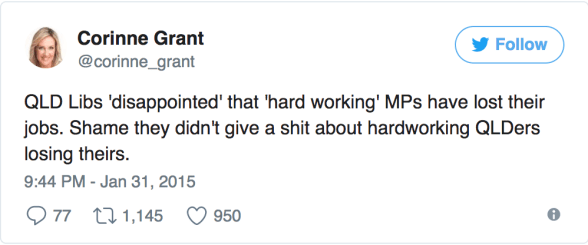
Grant’s tweet acknowledges the human consequences of policy, and clearly connected with a large number of people. When the human dimension of politics is continually lost or neglected, no amount of “communication focus” will change that.
The combined forces of social media, a more educated and aware public, and belief in consultative and participatory decision-making make political communication more complex and demanding. Politicians must now actually represent their constituents. To do so, they need to realise that communication requires deep understanding and to have something worth saying.
Everything else, as James Brown sang, is just “talking loud and saying nothin’”.
A prime example of “saying nothing” is the A$8 million government advertising campaign for its proposed changes to higher education. This campaign is the most recent example on a long list of failed, post-policy attempts by governments to communicate with the electorate.
The first Rudd Labor government tried it with the Mining Resources Rent Tax. Before that, the Howard government had an A$121 million campaign to explain WorkChoices, its workplace relations policy.
None of these campaigns substantially changed public opinion. Instead, they generated hostility and mobilised opposition. The public regard belated attempts to persuade them of the benefits of substantial policy change as a waste of time and money.

For decades, political communication treated the public as a mob of sheep that simply needed to be herded and pointed in the right direction with appropriate messages and the occasional dog whistle. Today, a more accurate metaphor for the public would be a murmuration of starlings – a mass of surging, synchronised individuals likely to move in an unpredictable direction.
Successful political communication must move from the one-sided broadcast model and become more dialogic. This requires listening – not just telling someone that you’re listening. It means paying attention to what they’re saying. Listening also requires being prepared to change opinions or behaviour in response to new information.
Dialogic communication in contemporary politics requires values, principles and policies to be better articulated, evidence-based and properly costed. The Australian polity will no longer accept anything less. Politicians and political parties need to remember that their fundamental ideology and policy priorities must be clear before they can be communicated to voters.
Pass the Parcel (Share) :
Posted: December 1, 2014 | Author: Fragmental | Filed under: Bits |
While I’ve been ‘researching’ and writing about technology, society, politics, popular culture, music, and other topics for years, I’ve resisted ‘blogging’. In part because I hate the word ‘blogging.” To me, it’s writing, and there’s certainly no shortage of writers. One more didn’t seem necessary. Except that I am a writer. I’ve made my living from writing and thinking, and thinking about writing, language and ideas, and I thought about how people scour the internet, skipping and surfing, looking for fragments of interest, for bits and pieces of fascination, curiosity, humour and insight. I do it, and I’m always hoping to find something that intrigues, stimulates or entertains and so I’ve joined the throng to produce, as well as consume.
I’m also inspired by the desire to move beyond the short posts of Facebook, occasional tweets, and the slow and arduous process of traditional publication in academia where it takes years before carefully crafted, work eventually reaches an audience of …. well mostly, it seems, zero.
In looking for a name I tried dozens. It was like trying to find a band name. I usually found that someone else had got there first and was already writing, or blogging, industriously under a name that I thought would be unique.
And then I discovered Fragmentalism, which is a term with quite a few definitions. According to Wikipedia it is an element of reductionism, “a philosophical position which holds that a complex system is nothing but the sum of its parts, and that an account of it can be reduced to accounts of individual constituents.” Fair enough, but “Reductmental” doesn’t quite have the same ring.
Fragmentalism has also been defined as the notion that knowledge is a growing collection of substantiated facts or “nuggets of truth.” I like that. Apparently “fragmentalism” has been used in many different disciplines and none of them agree, so its definition is somewhat, um, fragmented. Clearly, there’s a ‘bit’ of a theme developing here.
I prefer Yeats, “Things fall apart, the centre cannot hold.”
Wait, there’s more. But not all at once. It’s fragmented. Seriously.
Pass the Parcel (Share) :


 FRAGMENTAL